Showing posts with label Argentium silver. Show all posts

Tuesday, August 28, 2012

Does your silver tarnish?

In the past 6 years I’ve lost count of the number of times I’ve been asked this question…

It is clear to me many people are not aware sterling, argentium and fine silver will tarnish over time!  How fast sterling silver tarnishes depends on a number of things.  One contributing factor is how pure silver is.  Sterling silver is 92.5% silver and 7.5% another metal, usually copper; copper is one of the contribute factors to sterling silver tarnishing faster than fine silver.  This is due to the interactions between the silver, copper and sulfide in the air.  The sulfides are found in smoke from burnt raw fuel such as coal or oil, strong smelling foods such as eggs and onions, some fish or shell fish and of course air pollution.  I have actually blackened sterling silver a number of times with a hard-boiled egg by putting the egg yolk and the silver item in a baggy and letting sit until the silver “tarnished”, usually about 24 hours.    Some medications, particularly antibiotics can cause silver to tarnish, this I’d not heard of before.  During the tarnishing process it starts out as a yellowing effect, eventually going dark.  Humidity will result in silver tarnishing faster than usual.   Some people have more acid in there system and may see a discoloration on their skin while wearing silver!

Silver wire that is badly tarnished…it was bagged but not sealed and in the bottom of my silver container under many other bags, for some time...

 I've used sterling silver a great deal over the years and my experience has been some silvers tarnish much faster than others...which makes me believe the makeup of some silver has more copper or different additives as something is definitely different in order for it to tarnish at a faster rate?   The silver items are stored in the same place in the same manner.   I've made a point to purchase my sterling silver from one supplier for this reason and have consistently better results with regards to the issue of tarnishing.
Fine Silver is 99.9% pure silver, it tarnishes at a slower rate than sterling silver…the tarnish will generally be a discoloration rather than a dark tarnish as in the sterling silver, unless it is in an area where there are high pollution and sulpher levels, then it is more likely to be darker. Even so it is usually easier to clean and keep clean fine silver than sterling silver.

To prevent tarnish:
  •  One way to help prevent tarnish is to avoid contact with oils, salts and acids on your body…wiping your jewelry     after wearing will help prevent tarnish as our skin is a natural transfer for oils, acids and salts.   This particular statement is surprising to me, as my experience is the more I wear my silver jewelry pieces the less they tarnish…
  • Place jewelry in a baggy with an anti tarnish tab, this works…
  • I have always said the more you wear your jewelry the less it will tarnish…this has worked consistently for me, even though it isn’t supposed to?
  • Silica gel desiccant packets, the ones you get in shoe boxes, work well in a baggy to prevent tarnish! 
  • Apply a coat of Renaissance Wax; this is a microcrystalline food safe wax from England.  I’ve used this on occasion, but it is a wax, I don’t like the application process and it leaves a matt finish, which I don’t care for..it isn’t my favorite thing to use.
  • Apply a coat of Protectaclear…something I’m going to try.  Non toxic when dry, coating to last 10 years…
  • Apply nail polish but this will have to be done often as it wears/chips off very easily. Apply Vintaj Glaze…this is a metal sealer made specifically for metal jewelry.  I’m working with this glaze right now.   This product "Conforms to ASTM D-4236", which is a USA regulatory requirement for art materials, school supplies and toys such as crayons, paint sets, or modeling clay that parents, teachers and child care givers look for.
  • One other thing you can do is look for jewelry that is rhodium plated…this will not tarnish.  I purchase chain and findings that are rhodium plated when I can find.   Or you can buy jewelry that has already been oxidized; this jewelry will continue to oxidize but it won’t be noticeable the way it would be on bright silver.   I for one love the look of shiny, bright silver, but if someone requested a piece oxidized I’m happy to do that!

The difference after the top wire was cleaned with a cloth for a few seconds!

How to clean your jewelry
  • Simply wash your jewelry with a mild detergent that does not contain phosphate based chemicals when it is only slightly yellowing it will clean it up right away. Dry thoroughly...
  • Invest in a good cleaning cloth…rub your jewelry after you take it off to remove any beginning tarnish.  I generally do this before I wear a piece.
  • There are many silver polishes and dips available… I can’t recommend one as I don’t use them.  Research them carefully if you choose this method of cleaning.  Always remember to follow the directions if you decide to use commercial cleanser as failure to do so could result in damage to your jewelry!
  • Place baking soda in the bottom of a dish, lay your piece on top, they pour boiling water over top…the baking soda will bubble up and help to clean your silver…I’ve done this and it works very well on some pieces and not so good on others…it is definitely worth a try.  NOTE: wash your jewelry with mild detergent, rinse well with water and dry after doing this as the baking soda can etch the silver finish if not completely removed!
  •  NOTE:  do not use toothpaste as this is too abrasive for sterling silver or fine silver jewelry, pearls and some gems!

As I mentioned at the beginning of this post…I’m often asked if the pieces I make  will tarnish…as you’ve just read, the answer is simply, YES, all silver will eventually tarnish, even silver plated jewelry, copper and brass…but… it really doesn’t take a great deal of work to keep it sparkling clean.  All it takes is to keep a cleaning cloth with your jewelry and give it a quick rub before you put it on, then again when you take it off, at the very least do one or the other!  Place you silver jewelry in a baggy and you should be fine…

Send an email or leave a comment on my blog if you have any questions or comments…
Cheers

Information Source:
http://www.jivejewelry.com/blog/2007/02/why-does-sterling-silver-jewelry.html
http://www.newsletter.kaijewels.com/silver-tarnish.htm

Monday, July 23, 2012

Argentium, sterling & fine silver...what is the difference?

As promised...this post is to inform my customers and viewers what the difference is between argentium, sterling and fine silver...there really is a difference!

As most people know "Sterling Silver" does tarnish after time!  How fast silver tarnishes depend on the makeup, how it is stored, how often it is worn and where you live, as with all silvers.   Sterling silver is 92.5% silver and 7.5% another metal, usually copper; it is copper that contributes to sterling silver tarnishing faster than fine silver.  This is due to the exposure to the sulpher in the air, which is caused by pollution, and other sources of sulfides. During the tarnishing process it starts out as a yellowing effect, eventually going dark.   I've used sterling silver since 2007 and my experience has been some silver products tarnish much faster than others...which is why I consider the possibility that the makeup of some silver has more copper… my silver items are stored in the same place in the same manner!   I've made a point to purchase my sterling silver from one supplier whose product I’ve never been disappointed with.  


For the most part, since I began working with argentium and fine silver, I use sterling silver for ear wires and wire wrapping…last year when the silver prices were so high I chose to use silver sheet until we saw a bit of a decrease in price, then went back to argentium silver.


"Fine Silver" is 99.9% pure silver, with generally either copper or titanium to give it what strength it has but I find it too soft for large pieces.   It is brighter and shinier than sterling silver and a dream to fuse.  It will tarnish but slower than sterling silver and it will generally be a discoloration rather than a dark tarnish as in the sterling silver, unless it is in an area where there are high pollution and sulpher levels, then it is more likely to be darker.   Thankfully it is usually easier to clean fine silver than sterling silver.  It is a favorite of mine to work with which is why I've been using fine silver since 2009.   When I first began working with fine silver I tried a few solid sheet pendants but unfortunately from my experience, fine silver is truly too soft to use in this manner.   Now I use fine silver all the time to make hammered rings, earrings and circle/irregular pendants...generally I use 16 gauge wire and smaller for these items, once hammered they are nice and hard.  I will often combine it with argentium silver in my pieces.

There are other metals which can be added to silver instead of the copper, such as germanium, zinc and platinum, as well as additives such as boron and silicon.

The germanium is the additive in Argentium Sterling Silver ...this is sterling silver that has some of the copper replaced with a metalloid Germanium. It is the copper in sterling silver that contributes to the tarnish with exposure to air.   Argentium sterling silver is highly tarnish resistant, purer, brighter, and eliminates fire scale when using a torch...a dream come true as most of us dislike the tarnishing aspect of sterling silver!  
 If you would like more information regarding the wonderful Argentium sterling silver check out the website here...
http://www.argentiumsilver.com/home


Argentium silver and fine silver are more expensive than sterling silver but I prefer to use these products.  Having said that… I enjoy working with all three silver products and while I prefer one over the other for particular reasons I will always work with all three…now added to the line up is the new silver filled wire that I began using this spring. 


Feel free to ask a question, leave a comment or pass along topics you would like to see discussed regarding jewelry, stones, silver etc.   If I don't have the answer I will do the research and present my findings in a post. 
 
Watch for a new post every Monday...
Cheers...

hjcote11@gmail.com
NOTE:  this is a remake of a post I did in 2009.


Monday, July 9, 2012

What is Silver Filled and why I use it!


This post will explain why I’ve been using “silver filled” metals since May of 2012.
As people know the price of sterling silver fluctuates, it has steadily increased, albeit slowly since January of 2004.  I began working with silver in 2008…at this time the cost per ounce began a more aggressive increase until the prices peaked in September of 2011.   As of the writing of this post silver is still approximately 125% higher per ounce than it was when I made my first purchase in 2008.  This of course is why the public has seen increases in the cost of handmade silver pieces from Artisans.   There will always be those people who will buy silver jewelry regardless of the cost…but… for many people the cost of silver jewelry, while considerably improved is still too expensive.   Retail stores offer silver plated items for much less which makes it understandable why people gravitate to something more affordable.
With the “more affordable” idea in mind I decided this year to give a new product a try…”silver filled” sheet and wire.     In March of 2011 I heard about “silver filled” products from a friend, and briefly mentioned the product on my blog in the spring of 2011.   I purchased wire then stored it away, partly because it was new and I felt I had to wait bit to see how 
it held up.
In November of 2011 I purchased “silver filled sheet and wire”… which I also stored away until this spring when I began preparing for the opening of the North Bay Farmers Market. As this was a new product at the time, they only offered “silver filled” sheet, silver clad on one side…the other side has the brass (90% copper, 10%zinc) exposed, which wasn’t a concern my customers.   Even though I was aware of this product for over a year I wanted to make sure it was something that would stand the test of time before I introduced my customers to it this spring. 
 
My “silver filled” jewelry has been well received… selling itself…the reason being, it is relatively shiny, can be lightly hammered, stamped, sanded, soldered and tumbled like sterling silver, which allows me to offer earrings and pendants with the same look as the sterling silver  pieces.   It isn’t as sparkling as sterling but it definitely is worth the cost.  I recently purchased the double clad silver filled sheet, which they didn’t have the first time I ordered…(sterling silver on both sides)I must say I’m considering continuing to work with the one side sterling silver sheet, it allows people to tell the difference at a glance.
    
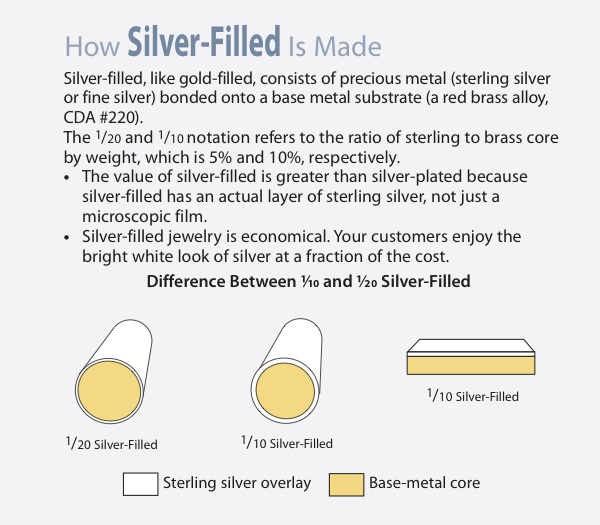
I explain “silver filled” in the following way to my customers …a layer of brass to which a layer of sterling silver has been permanently bonded…it will not wear off!  Like sterling silver it will tarnish so keep your pieces in a baggie with an anti tarnish tab, or clean gently with a cleaning cloth.  As with silver avoid exposing your pieces to hairspray or other harsh chemicals.  This product gives the look of sterling silver without the cost!

Below is an explanation from Rio Grande which gives the technical description. 

 
I will always work with sterling, argentium and fine silver as they are my favorite mediums… there are customers who prefer their jewelry made from sterling silver…but… the “silver filled” product fills a niche in the market…one I’m happy to be able to accommodate!

I will be doing a post soon to explain the difference between sterling silver, Argentium silver and fine silver as many of my customers ask me that question on a regular basis.

Cheers 

Posted on Baytoday July 9th, 2012