Showing posts with label birthstone of the month. Show all posts

Tuesday, August 7, 2012

Birthstone of the Month ~ August ~ Peridot (Olivine)


This striking green stone is also called Chrysolite and in the mineralogy world it is known as a variety of stone from the mineral family Olivine. It is thought the name Peridot comes from the Arabic word faridat which means "gem".   This beauty only comes in various shades of green, pale yellowish green, olive green, bottle green or a vibrant apple green, which is the most sought after, any shades of brown decrease the value of the stone.  In Pakistan, near the Afghan border you will find large Kashmir peridot stones which are the best for cutting, possessing intense striking color, which of course makes them expensive.  Most of the worlds Peridot, 80 to 95%, come from the San Carlos Reservation in Arizona, being mined by the Native Americans…finer quality gems come from Myanmar (formaerly Burma) and Egypt.  Other locations where peridot can be found are Australia, Brazil, China, South Africa, Hawaii, New Mexico and Zaire. 

Peridot Crystals in a Volcanic Bomb from Kilbourne Hole, Dona Ana Country, New Mexico
80mm x 60mm 200 grams

I'm including the definitions of igneous and metamorphic rocks as I think it helps to understand what these words mean...
Metamorphic Rocks
"The American Heritage Science Dictionary: 1. relating to metamorphosis. 2. Geology: Relating to rocks that have undergone metamorphism. Metamorphic rocks are formed when igneous, sedimentary, or other metamorphic rocks undergo a physical change due to extreme heat and pressure. These changes often produce folded layers or banding in the rocks, and they can also cause pockets of precious minerals to form. The folds and banding can be produced by incomplete segregation of minerals during re-crystallization, or they can be inherited from pre-existing beds in sedimentary rocks or pre-existing layers in igneous rocks. The precious minerals can form as the result of re-crystallization when the rocks undergoing metamorphism are subjected to changes in pressure and temperature.

  Natural Peridot Crystal from Sapat, Pakistan
17 mm x 12 mm, .65 inches x .5 inches

“Igneous: "
adjective
1. Geology...produced under conditions involving intense heat, as rocks of volcanic origin, or rocks crystallized from molten magma. 2. of, pertaining to, or characteristics of fire.
Intrusive Igneous Rock: forms beneath the surface of the volcano

Extrusive Igneous Rock: forms on the surface volcano"
Peridot, formed in the earth’s mantle, 20 to 55 miles inside a volcano…they are found in extrusive igneous rock forms, as a result of magma reaching the surface of the volcano, either from eruption, or cracks, fissures or as lava or ash.  It can also form in metamorphic rocks.   In other words it is found in the rocks formed by volcanoes.  The striking green color of the peridot comes from chemical composition of the stone (iron) itself and not from some other sources such as impurities.   Peridot is transparent but often includes some form of inclusion, they appear as spots or lines, and are naturally occurring deposits of such things as silica glass, biotite mica, and small crystals of pyrope garnet and spinal.   While lovely, the peridot is not a brilliant stone, it may have the appearance of glass or even look greasy…the stone may have a cat's eye or star effect but this is extremely rare.  Treatments, such as oiling or polymer filler may be used to improve the look of the stone, by decreasing the visibility of flaws. Care must be taken with the peridot as it is tends to burst under pressure, it is sensitive to heat and is not resistant to acids...so keep away from household cleaners, steam, hair spray, etc.
Faceted Peridot Gemstone, 6 mm x 4 mm 1.5 carats 
Stones of Interest:
  • A 319ct peridot found on the island of Zabargad is now in the Smithsonian Institution in Washington DC.
  • Cut stones from a meteorite that fell in 1749 in eastern Siberia are now in Russia.
  • 192.75 carat peridot stone belonging to the Czar is in the Diamond Registry in Moscow
Information of Interest:

  • Historians wonder if the gems worn by Cleopatra were actually peridot and not emeralds…
  • Some wear this stone as they believe it brings success, peace and good luck
  • It is the gift for the 16th wedding anniversary.
  • It is one of the few stones that comes in one color only
  • In ancient Egypt on an island called Zeberget mining for peridot was done at night as it was said the gemstone couldn’t be seen well during the day. 
  • I’ve seen the phonetic spelling as per-i-doe and per-i-dot…so not sure which is correct, I do think both are accepted.
  • Associated with light
  • Generally a transparent gem
  • Ancient records document peridot being mined back as far as 1500 B.C.
  • While it can be…this stone is generally not treated or enhanced
  • Relatively inexpensive in price
  • All be it rare, peridot have also been found in meteors  
  • Avoid ultrasonic cleaners, mild soap and water will clean this stone
  • Cracks easily so be gentle with it…
 Don’t forget…send any questions or comments to the following email address…

Cheers


Information courtesy of:
Special thanks to Maryanne Fender of Fender Minerals for allowing the use of their gorgeous gemstones…the Volcanic Bomb was found in Kilbourne Hole, New Mexico.
   
·         Gemstones of the World,Walter Schumann, Third Edition, Sterling Publishing Co.
·         The Jeweler's Directory of Gemstones, Judith Crowe, Firefly Books, 2006
·         "igneous." dictionary.com Unabridged (v 1.1). Random House, Inc. 21 Aug. 2008. dictionary.com http://dictionary.reference.com/browse/igneous
·         "Metamorphic" The American Heritage® Science Dictionary. Houghton Mifflin Company.  21 Aug. 2008. dictionary.com   http://dictionary.reference.com/browse/metamorphic

Monday, July 16, 2012


The Birthstone for the month of July is the stunning Ruby!!
Along with the sapphire, emerald and diamond, the ruby is considered a precious stone. The ruby and its sister stone the Sapphire are a member of the corundum species...the word corundum means “very hard mineral used as an abrasive”.   You might be surprised to know the only difference between the ruby and the sapphire is the color.  
Rubies are found in Afghanistan, Australia, Cambodia, India, Kenya, Pakistan (Kashmir), Russian, United States, (North Carolina), Greenland and Vietnam, with some of the most important finds in Myanmar (formerly Burma), Tanzania, Thailand, and Sri Lanka. 

Deep Red Natural Ruby Crystal and Natural Faceted Ruby Cut StoneA composite terminated crystal from Madagascar and a Burmese (Myanmar) Faceted Stone, both natural

The ruby ranges in color from pink to blood-red in color.  The most desirable red (Latin – ruber) being blood red with a touch of blue, which is called “pigeon’s blood”.  The presence of chromium provides the red and the presence of iron explains any brown tones.  The color of the ruby will vary within each deposit making it difficult to determine the location where found by looking at the gem. When you hear “Burma ruby” or Siam ruby” more often this is referring to the quality not the source location of the gem.

The color is often uneven with stripes and spots throughout the gem, all natural rubies have imperfections including impurities and inclusions such as the needle like rutile, known as “silk” which the Gemologist uses to determine the real ruby from the synthetic ruby.  Rubies with a 3 or 6-point star are cut into cabochons to show the star effect. The presence of chromium provides the red and the presence of iron explains any brown tones.
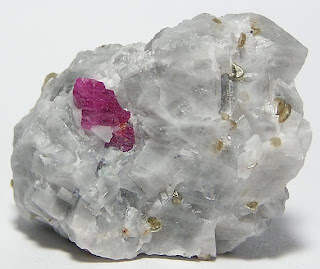
Ruby Pyrite Marble Matrix Natural Mineral Specimenfrom Ganesh, Hunza Valley, PakistanThis marble containing corundum (the mineralogical name for ruby and saphhire) runs all the way from Afghanistan to Burma (Myanmar).
The ruby in its rough form is dull and greasy, as are most gems, but it is said once the gem is cut “the luster can approach that of the diamond “.  Since the 1960’s it has become common for the ruby to be treated with heat to improve the color, as a result the cost of a natural untreated Burmese ruby of 10ct would be on par with a natural diamond!    Having said that the ruby is one of the most expensive gems, with large ones worth more than diamonds, which is why they are often used for royalty/wealthy jewelry and insignia.
  
Ruby in Fuchsite (green mica) Puff Heart CabochonPuff Pillow cabochonBoth sides polishedStone mined and cut in India 
The ruby is hard with only the diamond harder, but it lacks cleavage*, as a result the ruby is brittle therefore, cutting and setting the stone must be done carefully.
Cleavage*: “Crystal can break along the lines of weakness related to the atomic structure (cleavage) in such a way that a flat surface which is called a cleavage plane is left. Where the break is not related to the fracture, the resulting surface will not be flat or smooth.  Fracture may be described as uneven, splintery.  Cleavage and fracture affect the strength of a gemstone as well as how easy it can be worked/cut/shaped”.

I admit I was surprised to find the natural, untreated ruby is such a valuable gem.  

Some interesting information:
  • The ruby is used to celebrate the 15th and 40th wedding anniversary.
  • It is used in ancient times for bad health and to protect against misfortune.
  • Placed on building to ensure good fortune to the building.
 
Don’t hesitate to contact me with any questions or requests!
     

Watch for healing aspects of semi and semi precious stones coming soon…
Cheers

  • Gemstones of the World, Walter Schumann,Third Addition,Sterling Publishing Co.Inc.
  • The Jeweler's Directory of Gemstones, Judith Crowe, Firefly Books, 2006


Thursday, August 21, 2008

"Birthstone of the Month" Peridot (Olivine)


This striking green stone is also called Chrysolite and in the mineralogy world it is known as Olivine. It is thought the name Peridot comes from the Arabic word faridat which means "gem". This beauty only comes in various shades of green, pale yellowish green, olive green, bottle green or a vibrant apple green, which is the most sought after. In Pakistan, near the Afghan border you will find large Kashmir peridot stones which are the best for cutting, possessing intense striking color, which of course makes them expensive. Other locations where peridot is found is, Australia, Brazil, China, Egypt (St.John's Island), Myanmar (formerly Burma), South Africa, United States (Hawaii, Arizona) and Zaire.


I'm including the definitions of igneous and metamorphic rocks as I think it helps to understand what these words mean...

Metamorphic Rocks
"The American Heritage Science Dictionary: 1. Relating to metamorphosis. 2. Geology: Relating to rocks that have undergone metamorphism. Metamorphic rocks are formed when igneous, sedimentary, or other metamorphic rocks undergo a physical change due to extreme heat and pressure. These changes often produce folded layers or banding in the rocks, and they can also cause pockets of precious minerals to form. The folds and banding can be produced by incomplete segregation of minerals during recrystallization, or they can be inherited from preexisting beds in sedimentary rocks or preexisting layers in igneous rocks. The precious minerals can form as the result of recrystallization when the rocks undergoing metamorphism are subjected to changes in pressure and temperature.

"
Igneous: "
adjective
1. Geology...produced under conditions involving intense heat, as rocks of volcanic origin, or rocks crystallized from molten magma. 2. of, pertaining to, or characteristics of fire.

Intrusive Igneous Rock: forms beneath the surface of the volcano
Extrusive Igneous Rock: forms on the surface volcano"

Peridot, which is an extrusive igneous rock forms as a result of magma reaching the surface of the volcano, either from eruption, or cracks, fissures or as lava or ash. It can also form in metamorphic rocks. The striking green colors of the peridot comes from its own chemical composition of the stone (iron) itself and not from some other sources such as impurities. Peridot is transparent but often includes some form of inclusion, they appear as spots or lines, and are naturally occurring deposits of such things as silica glass, biotite mica, small crystals of pyrope garnet and spinel. While lovely, the peridot is not a brilliant stone, it may have the appearance of glass or even look greasy, rarely, the stone will have a cat's eye or star effect. Treatments, such as oiling or a polymer filler may be used to improve the look of the stone, by decreasing the visibility of flaws. Care must be taken with the peridot as it is tends to burst under pressure, it is sensitive to heat and is not resistant to acids...so keep away from household cleaners, steam, etc.


Stones of Interest:
  • A 319ct perito found on the island of Zabargad is now in the Smithsonian Institution in Washington DC.
  • Cut stones from a meteorite that fell in 1749 in eastern Siberia are now in Russia.
As always, I hope you found the Peridot information interestingly informative!!
Cheers


Information courtesy of: Gemstones of the World,Walter Schumann, Third Edition, Sterling Publishing Co., The Jeweler's Directory of Gemstones, Judith Crowe, Firefly Books, 2006 "igneous." dictionary.com Unabridged (v 1.1). Random House, Inc. 21 Aug. 2008. dictionary.com http://dictionary.reference.com/browse/igneous "metamorphic" The American Heritage® Science Dictionary. Houghton Mifflin Company. 21 Aug. 2008. dictionary.com http://dictionary.reference.com/browse/metamorphic
The two photos of the raw peridot are courtesy of @Edith Ochs - Fotolia.com, thank you.
The lovely peridot ring photo is courtesy of @K. Geijer - Fotolia.com, thank you.